Self-awareness isn’t something you’re born with—it’s something you build. And in a world that constantly pulls your attention outward, learning to turn inward is one of the most powerful advantages you can develop.
It affects everything: your relationships, your decisions, your emotional stability, even your sense of purpose. Without self-awareness, you don’t just repeat habits—you repeat outcomes. Over time, this creates what many experience as karmic cycles. Without self-awareness, you react. With it, you respond.
The good news? It’s a skill—and like any skill, it can be trained.
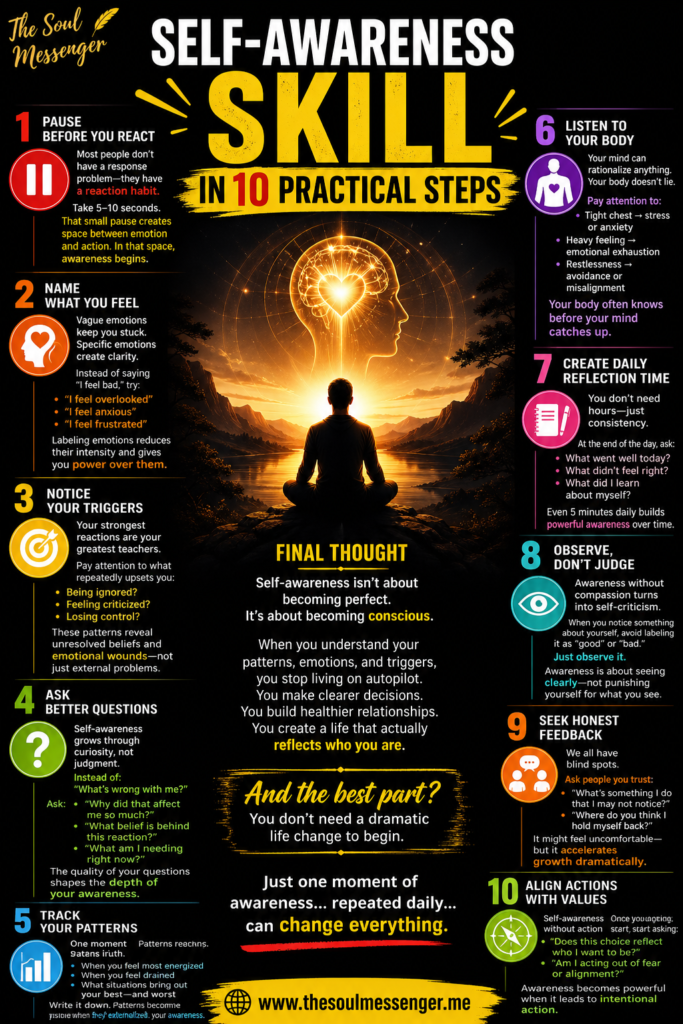
Here are 10 practical, real-life ways to build self-awareness starting today:
1. Pause Before You React
Most people don’t have a response problem—they have a reaction habit.
The next time something triggers you, don’t respond immediately. Take 5–10 seconds. That small pause creates space between emotion and action. In that space, awareness begins.
2. Name What You Feel
Vague emotions keep you stuck. Specific emotions create clarity.
Instead of saying “I feel bad,” try:
- “I feel anxious “
Labeling emotions reduces their intensity and gives you power over them.
3. Notice Your Triggers
Your strongest reactions are your greatest teachers.
Pay attention to what repeatedly upsets you:
- Being ignored?
- Feeling criticized?
- Losing control?
These patterns reveal unresolved beliefs and emotional wounds—not just external problems.
4. Ask Better Questions
Self-awareness grows through curiosity, not judgment.
Instead of:
- “What’s wrong with me?”
Ask:
- “Why did that affect me so much?”
- “What belief is behind this reaction?”
- “What am I needing right now?”
The quality of your questions shapes the depth of your awareness.
5. Track Your Patterns
One moment means little. Patterns reveal truth.
Start noticing:
- When you feel most energized
- When you feel drained
- What situations bring out your best—and worst
Write it down. Patterns become visible when they’re externalized.
6. Listen to Your Body
Your mind can rationalize anything. Your body doesn’t lie.
Pay attention to:
- Tight chest → stress or anxiety
- Heavy feeling → emotional exhaustion
- Restlessness → avoidance or misalignment
Your body often knows before your mind catches up.
7. Create Daily Reflection Time
You don’t need hours—just consistency.
At the end of the day, ask:
- What went well today?
- What didn’t feel right?
- What did I learn about myself?
Even 5 minutes daily builds powerful awareness over time.
8. Observe, Don’t Judge
Awareness without compassion turns into self-criticism.
When you notice something about yourself, avoid labeling it as “good” or “bad.” Just observe it.
Awareness is about seeing clearly—not punishing yourself for what you see.
9. Seek Honest Feedback
We all have blind spots.
Ask people you trust:
- “What’s something I do that I may not notice?”
- “Where do you think I hold myself back?”
It might feel uncomfortable—but it accelerates growth dramatically.
10. Align Actions With Values
Self-awareness without action changes nothing.
Once you understand yourself better, start asking:
- “Does this choice reflect who I want to be?”
- “Am I acting out of fear or alignment?”
Awareness becomes powerful when it leads to intentional action.
Final Thought
Self-awareness isn’t about becoming perfect. It’s about becoming conscious.
When you understand your patterns, emotions, and triggers, you stop living on autopilot. You make clearer decisions. You build healthier relationships. You create a life that actually reflects who you are.
And the best part?
You don’t need a dramatic life change to begin.
Just one moment of awareness… repeated daily… can change everything.