When Feeling Unloved: Healing the Younger Part of You
There is a particular kind of loneliness that can follow you even when you are surrounded by people. It is sometimes regarded as the pain of feeling unloved.
You can grow older, build a life, become independent, and learn how to handle almost anything on your own—and still carry a quiet longing inside you.
The longing to be chosen.
To be understood.
To feel safe enough to stop pretending that everything is okay.
Sometimes, that longing doesn’t begin in adulthood. Sometimes, it belongs to the younger version of you who simply wanted to feel loved, accepted, protected, and important.
The Child You Never Stopped Being
Some needs don’t disappear with age. Feeling unloved can emerge when some of our needs remain unmet.
As we grow up, we often learn how to function without the things we once desperately needed.
We learn to take care of ourselves.
We learn not to ask for too much.
We learn to hide our disappointment.
We learn to say, “I don’t need anyone,” even when a part of us desperately wishes someone would simply stay.
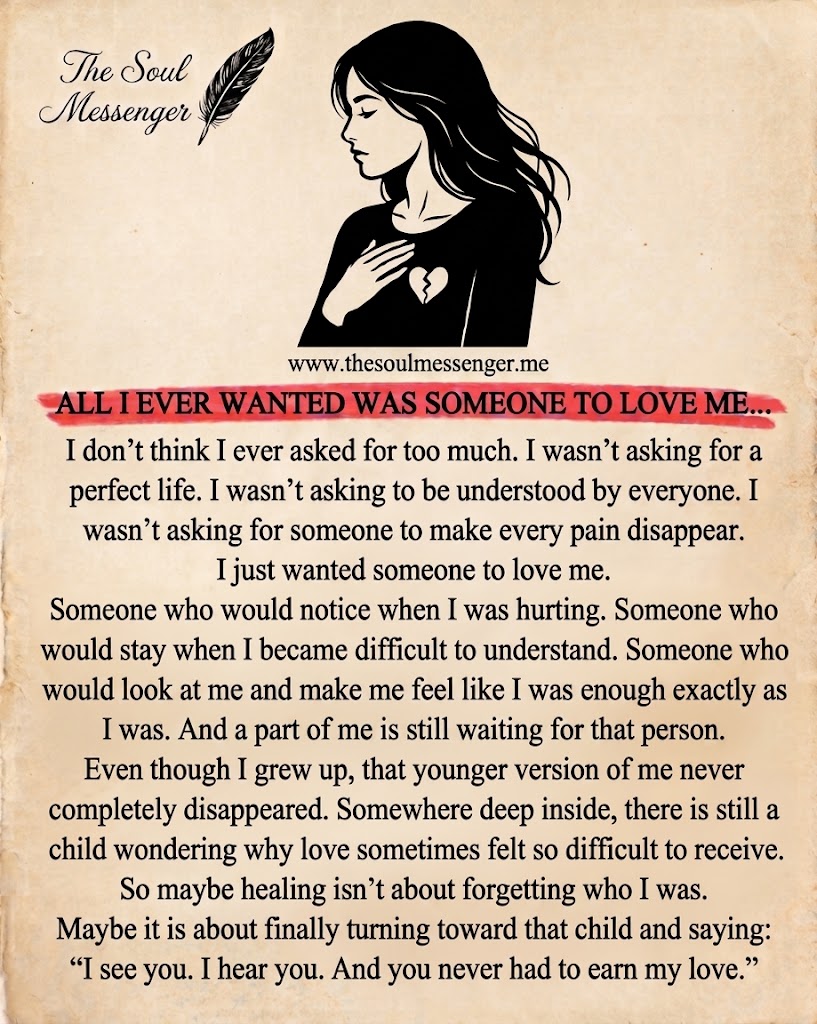
But growing up doesn’t mean that the emotional needs we had as children suddenly disappear.
The younger self remains part of our story.
And sometimes, that younger self quietly influences the way we approach relationships, affection, rejection, and even our own sense of worth.
Maybe you became the person who gives too much because you learned that love had to be earned.
Maybe you became afraid of being abandoned because someone important once made you feel replaceable.
Maybe you became extremely independent because depending on others once left you disappointed.
Or perhaps you simply learned to expect less because expecting love felt more painful than living without it.
When Feeling Unloved Follows You Into Adulthood
Sometimes, we don’t realize how deeply feeling unloved can shape the way we see ourselves and the relationships we create.
We may become overly focused on whether someone is staying, whether they care, whether they are pulling away, or whether we are somehow becoming “too much.”
And underneath all of it may be an old fear:
“Will I ever be chosen?”
When You Spend Your Life Looking for Love
The search to finally feel chosen.
Sometimes we don’t realize how much of our adult life can become a search for something we missed earlier.
We look for the person who will finally make us feel worthy.
We hope a relationship will fill the emptiness.
We look for reassurance that we are beautiful enough, interesting enough, important enough, and lovable enough.
And when someone leaves, pulls away, or doesn’t love us in the way we hoped, the pain can feel much bigger than the situation itself.
Because it may touch something much older. It touches the wound of feeling unloved
It may awaken that familiar question:
“What is wrong with me?”
But perhaps that is the question we need to stop asking.
Maybe the better question is:
“What happened to me that made me believe I wasn’t worthy of love?”
There is a difference.
One blames you.
The other invites you to understand yourself.
Your Younger Self Deserves Your Compassion
You don’t have to judge the person you once were.
Healing doesn’t require you to rewrite your childhood or pretend that everything was okay.
It doesn’t require you to blame everyone who ever hurt you either.
Sometimes healing begins much more quietly.
It begins with compassion.
Imagine the younger version of yourself sitting across from you.
What would you say to that child?
Would you tell them they were too sensitive?
Would you tell them they should have known better?
Would you tell them they needed to try harder to be loved?
Probably not.
You would probably look at them with tenderness.
You would tell them that they deserved kindness.
You would remind them that being rejected did not make them unworthy.
You would tell them that someone else’s inability to love them properly was never proof that they were difficult to love.
And perhaps that is the compassion you need to offer yourself today.
Learning to Heal the Pain of Feeling Unloved
There is something deeply powerful about becoming the safe person your younger self needed.
It doesn’t mean that you no longer need other people.
We are human. We need connection, affection, friendship, intimacy, and belonging.
But there is a difference between wanting love and believing that someone else must love you in order for you to have worth.
You can desire a deep relationship without abandoning yourself to keep one.
You can love someone without constantly proving that you deserve to be loved back.
You can walk away from relationships that repeatedly make you question your worth.
And you can begin creating an inner relationship based on patience instead of criticism.
Start With One Simple Promise
Perhaps your younger self doesn’t need a grand promise from you.
Perhaps it simply needs consistency.
When you are tired, listen to yourself.
When you make a mistake, speak to yourself with kindness.
When someone rejects you, don’t immediately turn their decision into a judgment about your worth.
When you feel lonely, don’t shame yourself for wanting connection.
And when old pain resurfaces, don’t tell yourself that you should be “over it” already.
You are allowed to heal at your own pace.
You Were Never Too Much
Maybe you spent years believing you were too emotional, too sensitive, too needy, too complicated, or simply not enough.
But being deeply affected by life does not make you weak.
Wanting affection does not make you needy.
Wanting someone to stay does not make you desperate.
And having a younger part of yourself that still longs to feel safe does not mean you are broken.
It means you are human.
The goal isn’t to become someone who never needs love.
The goal is to become someone who knows that love should not require the destruction of their own identity.
Come Back to Yourself
One day, you may realize that the person you have been waiting for cannot come back and change the past.
But you can.
You can come back to yourself.
You can listen to the parts of you that have been ignored.
You can stop treating your wounds as weaknesses.
You can learn to recognize healthy love.
And you can begin giving yourself the compassion you once hoped someone else would give you.
Maybe that is what your younger self has been waiting for all along.
Not perfection.
Not another person to rescue you.
Just you.
And perhaps, when you stop chasing external proof that you are worthy, the quiet pain of feeling unloved begins to lose its power over you.
You don’t have to become someone else to deserve love.
You don’t have to earn your place in someone’s heart.
You don’t have to abandon yourself just to make someone stay.
You can begin here.
With yourself.
With compassion.
With the decision to finally become the safe place you have been searching for.
The adult you have become finally turning around, reaching back through the years, and saying:
“I see you. I hear you. I understand why you were hurting. And you never had to earn my love.”
Because perhaps the deepest healing isn’t about finally finding someone who will love you.
Perhaps it is about finally believing that you have always been worthy of love.