Feeling overwhelmed and unable to understand what you feel? Learn how to decode emotions and find clarity when everything feels too intense.
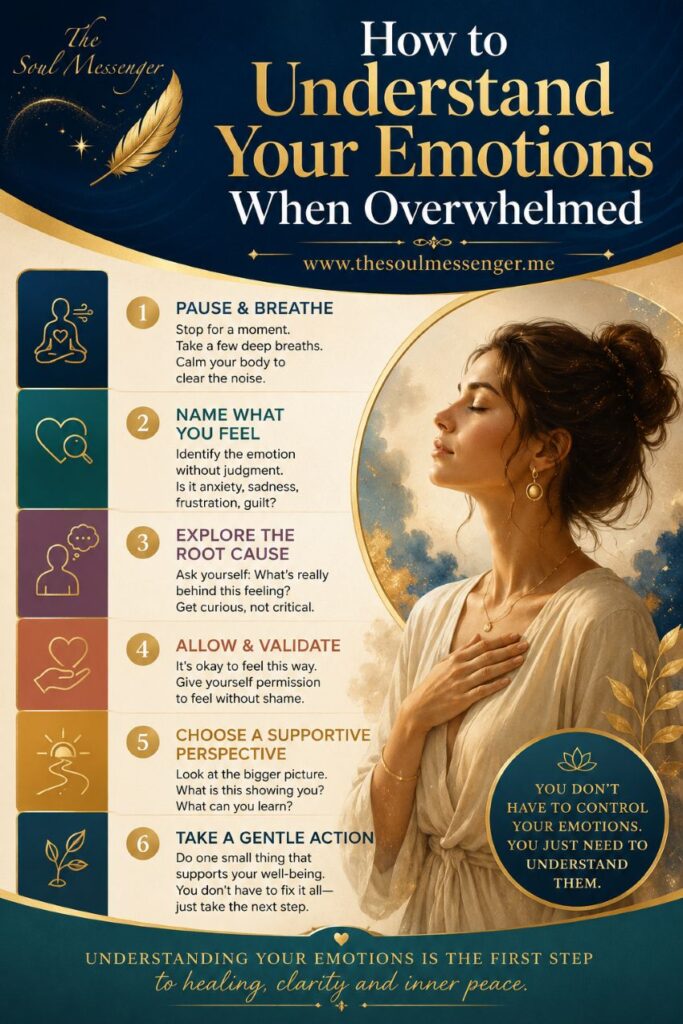
I used to think my emotions were the problem. Too deep. Too fast. Too confusing. One moment I felt everything. The next, I couldn’t explain anything. And if you’re here, you probably know that feeling too — when your heart speaks in waves, but your mind can’t translate. This is not a guide to fixing your emotions. This is a guide to finally understanding them.
What You Feel Is Not Random — It’s Layered
Most people think emotions are simple. Happy. Sad. Angry. Calm. But what you feel is rarely just one thing. It’s a mix of:
- memory
- fear
- intuition
- unspoken truth
An emotion is not a reaction. It is information trying to reach your awareness. Research in psychology supports the idea that emotions function as internal signals that help guide behavior and decision-making.
When emotional intensity feels unclear or overwhelming, it is often connected to deeper emotional truth that is not fully seen or acknowledged. This connects closely to The Truth You Are Avoiding Right Now, where this inner pattern is explored more deeply.
The Moment I Realized I Was Misreading Myself
I once felt intense anger toward someone I loved. Sharp. Immediate. Uncomfortable. I almost reacted. I almost said something I couldn’t take back. But instead, I paused.
And underneath the anger…was fear. Fear of being misunderstood. Fear of losing connection.
That changed everything.
Tool #1: The “What Is Beneath This?” Question
When you feel something strong, don’t trust the first emotion. Always try to decode emotions.
Ask yourself:
- What is beneath this?
- What am I actually afraid of right now?
- What does this feeling want me to see?
Example:
- Irritation → need for space
- Jealousy → fear of not being enough
- Overthinking → lack of safety
This is where clarity begins.
You Feel Fast Because You Perceive Deeply
Some people process emotions slowly.
Others feel everything instantly.
If you’re the second type, it can feel overwhelming.
But there’s a truth no one tells you:
You’re not too emotional. You’re just processing in real time.

Tool #2: Name It Without Explaining It
You don’t need to justify what you feel. You just need to name it.
Instead of:
“I don’t know why I feel weird…”
Try:
- “I feel unsettled.”
- “I feel disconnected.”
- “I feel emotionally full.”
Naming an emotion reduces its intensity by bringing it into awareness.
The Day I Stopped Fighting My Feelings
I used to try to control everything I felt.
To stay calm. To stay balanced. To stay “okay.”
But suppressed emotions don’t disappear.
They wait.
And then they come back louder.
So I tried something different.
I let myself feel — without reacting.
That’s when emotions stopped controlling me.
Tool #3: Feel Without Acting
Not every emotion needs a response.
Sometimes, the most powerful thing you can do is:
- sit with it
- breathe through it
- observe it
Example:
You feel anger → instead of texting → go for a walk
You feel sadness → instead of distracting → sit quietly for 5 minutes
You’ll notice something surprising:
Emotions move when you don’t resist them.
You’re Not Confused — You’re Overloaded
When too many emotions come at once, your system freezes.
That “I don’t know what I feel” moment?
It’s not confusion.
It’s overload.
Tool #4: Break It Into Parts
Instead of asking:
“What do I feel?”
Ask:
- What do I feel in my body?
- What thought keeps repeating?
- What triggered this?
Example:
- Tight chest → anxiety
- Repeating thought → “I’m not enough”
- Trigger → someone’s tone
Now the emotion becomes clear.
Your Body Knows Before Your Mind Does
Before you understand a feeling, your body already reacts.
That’s why you might feel:
- tension
- heaviness
- restlessness
before you can explain why.
Definition:
The body is the first language of emotion.
Tool #5: The 3-Minute Body Check
Pause and ask:
- Where do I feel this?
- Is it heavy, sharp, or tight?
- Does it want movement or stillness?
Example:
- Tight shoulders → release → stretch
- Heavy chest → breathe slowly
- Restlessness → move your body
Understanding begins in the body.
The Truth About Emotional Intensity
If you feel deeply, you don’t just experience life — you absorb it.
You notice tone. Energy. Silence.
Things others ignore.
That’s not a weakness.
But without awareness, it can become overwhelming.
Tool #6: Separate What’s Yours and What’s Not
Not every feeling you carry belongs to you.
Ask:
- Is this mine?
- Or did I pick this up from someone else?
Example:
You feel drained after being with someone → it’s not your emotion
You feel anxious in calm situations → something external is influencing you
This alone can change your emotional clarity.
You Don’t Need to “Figure It All Out”
Some feelings don’t need analysis.
They need space.
The need to understand everything instantly…
often creates more confusion.
Tool #7: Give It Time Instead of Pressure
Say:
“I don’t fully understand this yet — and that’s okay.”
Clarity comes when you stop forcing it.
The Quiet Shift That Changed Everything
Understanding your emotions isn’t about control.
It’s about relationship.
When you stop fighting what you feel…
you start hearing what it’s trying to tell you.
A Simple Everyday Practice
At the end of the day, ask yourself:
- What did I feel most today?
- When did it start?
- What did it need from me?
No judgment. No fixing. Just awareness.
Final Truth
You were never “too emotional.” You were just never taught how to understand yourself. And once you do…your emotions stop being overwhelming —and start becoming your guidance.