Understanding the Survival Mode Life You Didn’t Choose
There is a version of you that moves through the world without thinking, without feeling fully safe, feeling lost most of the time and without ever truly resting inside yourself. That is what we call a survival mode life.
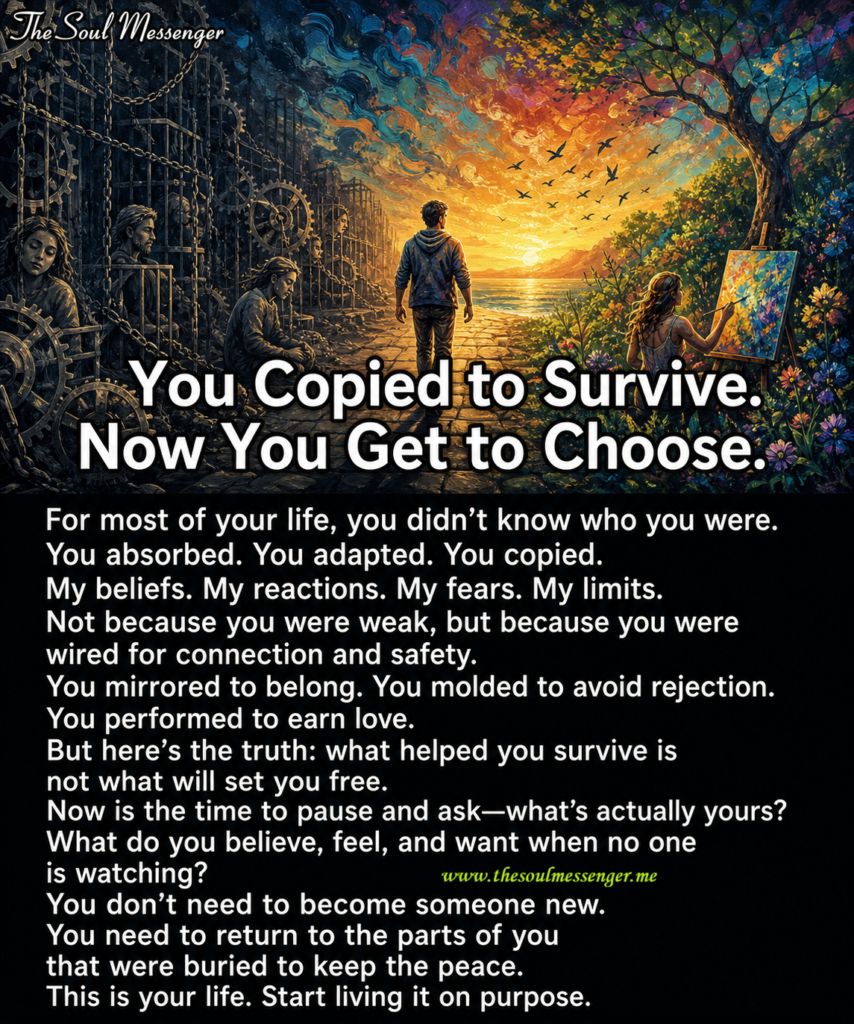
It is not a personality. It is not your identity. It is a response.
A response to emotional pressure. To childhood expectations. To environments where you had to stay alert, adjust, please, hide, or perform in order to be accepted or safe.
And over time, this response becomes automatic. You don’t notice when it starts running your decisions. You just feel tired, disconnected, or like something inside you is missing—but you can’t explain what.
This is why the title is true in a deeper sense: the painful survival life you’re living isn’t the real you. It is what you had to become to get through what you were in.
How a Survival Mode Life Becomes Your Identity
A survival mode life doesn’t begin loudly. It begins quietly.
You learn things like:
- Don’t speak too much, or you’ll be judged
- Be useful, or you won’t be valued
- Stay strong, or you’ll be a burden
- Adapt, or you’ll be rejected
So you adapt.
You become the “easy one,” the “strong one,” the “helper,” the “quiet one,” the “successful one,” or the “emotionally controlled one.”
And slowly, your natural reactions get replaced with survival strategies:
- You say yes when you mean no
- You disconnect from your own needs
- You overthink every interaction
- You measure your worth through others
- You feel safer performing than being
This is not weakness. It is adaptation.
But over time, the survival mode life starts to feel like exhaustion with no clear cause.
Because you are no longer responding to danger—you are living inside a pattern that believes danger is always near.
Signs You Are Living in a Survival Mode Life
If you are in a survival mode life, you might recognize some of these patterns:
- You feel tired even after resting
- You struggle to relax without guilt
- You overanalyze simple situations
- You feel disconnected from your own desires
- You constantly adjust to other people’s moods
- You feel like you are “performing” your life
- You don’t know what you actually want anymore
These are not flaws. They are signals.
Signals that your nervous system has been operating in protection mode for too long.
And the painful part is this: the longer it continues, the more it feels like “this is just who I am.”
But it isn’t.
The Truth Behind Your Survival Mode Life
Underneath every survival mode life, there is a self that has been paused.
Not destroyed. Not lost. Paused.
This version of you:
- Feels without filtering
- Chooses without fear
- Speaks without rehearsing
- Exists without permission
But it has been buried under years of adaptation.
So what you experience as “personality” is often just repetition of survival patterns.
This is why change doesn’t come from forcing positivity or discipline alone. It comes from recognizing the pattern you are inside.
How to Begin Healing a Survival Mode Life (Practical Steps)
You don’t escape a survival mode life by rejecting it. You move through it by slowly teaching your system that it is no longer in danger.
Here are practical ways to start:
1. Practice Micro-Honesty Daily
Instead of big life changes, start with small truths:
- “I don’t feel like talking right now.”
- “I need more time to think.”
- “I actually prefer something different.”
These small acts rewire your internal permission system.
You are teaching yourself: my truth is safe to express.
2. Pause Before Automatic Yes
People in survival mode life often say yes before they even feel the decision.
Start pausing:
- “Let me think about it.”
- “I’ll get back to you.”
This creates space between stimulus and response—the space where your real self begins to return.
3. Reconnect With Body Signals
Your body often knows before your mind does.
Ask daily:
- Do I feel tight or relaxed right now?
- Do I feel open or closed?
- Am I forcing or flowing?
A survival mode life disconnects you from your body. Reconnection brings you back.
4. Reduce Performance-Based Living
Notice where you are performing:
- Social situations
- Work identity
- Relationships
Then ask:
“What would I do here if I didn’t need approval?”
Even if you don’t act on it immediately, awareness weakens the survival script.
5. Create Safe Solitude
Not isolation—solitude.
Spend time where:
- You are not needed
- You are not performing
- You are not explaining yourself
In this space, your nervous system begins to soften. And what was buried slowly rises again.
Returning From a Survival Mode Life
Healing is not about becoming someone new.
It is about unlearning what you had to become.
You don’t erase the survival mode life—you thank it for what it did for you, and then slowly step out of it.
At first, it feels unfamiliar. Even uncomfortable. Because your nervous system trusts the old patterns more than the unknown.
But underneath that discomfort is something very simple:
You are not meant to live in constant adaptation.
You are meant to exist in alignment.
And the moment you begin noticing your survival mode life instead of being fully inside it, change has already started.
Not as a transformation overnight—but as a return.
A return to the version of you that was never gone, only covered.
Final Reflection
The painful survival life you’re living isn’t the real you.
It is the version of you that learned how to stay safe in environments that required adaptation over authenticity.
But you are no longer only what you had to become.
And slowly, choice by choice, pause by pause, truth by truth—you begin to return.