The Realization
It was just an ordinary day. Nothing special. Just the usual activities, the usual everyday routine. Self-abandonment was not even a mere thought.
I was in a hurry, moving through my day, when suddenly something unusual clicked in my mind—
I was always putting others first, except me.
This was not an exception—this was the rule.
But because I was busy, I didn’t pay much attention to it. Still, the thought lingered in the background, quietly following me through my routines, decisions, and behaviors.
Until I could no longer ignore it.
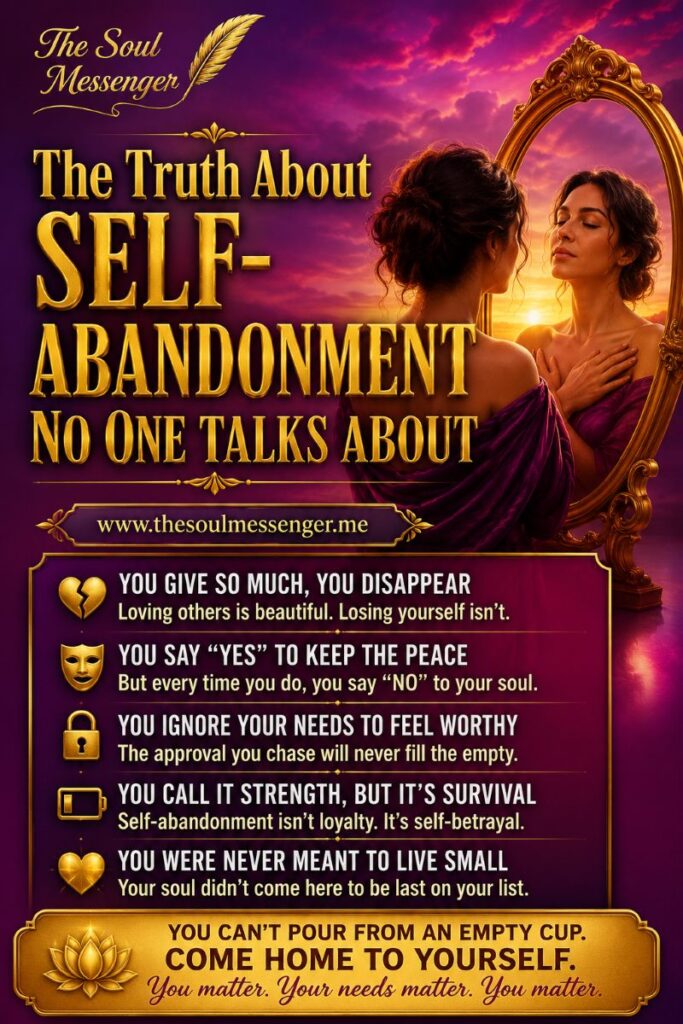
And the pattern was always the same: I was choosing others first and putting myself last unconsciously, while my own needs and well-being were always neglected—always last.
And what shocked me even more was that sometimes there wasn’t enough time, energy, or money left for my needs to be met at all.
That realization made me stop for a moment.
I started asking myself:
What am I actually doing?
Why am I living like this?
Is this self-sacrifice?
It became clear that this was not a conscious choice. I wasn’t deciding this—it was something I had been doing unconsciously.
And something inside me knew:
This had to stop.
This had to change.
I don’t want to live like this for the rest of my life.
The Breaking Point of Self-Abandonment
I started wondering what the reason might be.
Was I simply wired to take care of others, to be responsible for everything and everyone except myself?
And while caring for others felt like a natural part of me, I suddenly saw how deeply wrong this pattern had become.
I didn’t want this anymore. I felt exhausted.
Everyone is responsible for themselves. I don’t want to carry what is not mine to carry.
The Boundary & Self-Claiming
Before, I was freely offering myself without realizing I was slowly self-sabotaging my own life.
Now it is different.
If something is not my responsibility, I am leaving it where it belongs—with the person it belongs to.
And because I used to be deeply conditioned into over-responsibility, I now see things differently.
No more carrying what has nothing to do with me.
I am done with the self-abandonment pattern.
From now on, whenever I do something, I will ask myself:
Does this actually belong to me?
Is this truly my responsibility?
Am I losing myself in the process of taking this on?
And when someone asks me for a favor, if I don’t feel like doing it, I will simply say: Sorry, I can’t.
I am learning that I don’t need to over-explain or over-apologize for that.
Because saying no is not wrong—it is simply a boundary.
And the more I repeat my boundary, the stronger it becomes.
The time has come for self-claiming—to choose myself fully and unapologetically.
And it feels liberating in a way I can’t fully describe.
Like coming home to myself after being lost in the dark for a very long time.