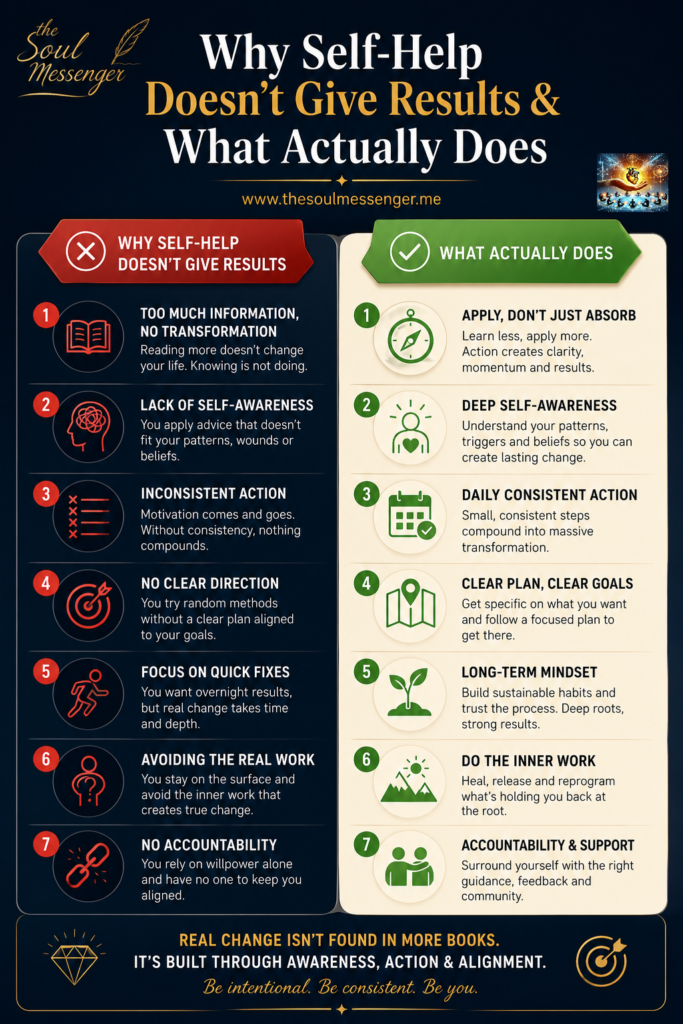
At some point, many people quietly reach the same frustrating conclusion that self-help doesn’t give results and it is not working the way they expected. You read the books, watch the videos, do journaling, try meditation, repeat affirmations, analyze your childhood, and still—something inside feels unchanged.
On the surface, it looks like you’re “doing the work.” But inside, the same patterns repeat. You still overthink. You still react emotionally in the same situations. You still feel stuck in the same identity, even after months or years of effort.
This creates a confusing question: If I’m doing everything right, why isn’t anything actually changing?
The answer is not that inner work is useless. The issue is that most people are working at the wrong level of change.
1. The biggest misunderstanding: thinking awareness alone creates change
One of the most common traps in self-help is the belief that understanding something automatically heals it.
You might think:
- “Now I understand my trauma.”
- “Now I know why I react like this.”
- “Now I see my patterns clearly.”
But awareness is only the first layer.
Awareness without emotional integration is like reading a manual for swimming without entering the water.
You understand it—but your nervous system still behaves the same way.
What actually works instead:
Real change happens when awareness is combined with felt experience.
Not just thinking about emotions—but allowing the body to process them safely in real time.
Try this:
- When a strong emotion appears, stop analyzing it immediately
- Instead of asking “why do I feel this?”, ask “where do I feel this in my body?”
- Stay with physical sensation for 30–90 seconds without trying to change it
This is where real rewiring begins—not in analysis, but in presence.
2. You are trying to change thoughts instead of patterns
Another reason self-help and inner work not working is because most techniques focus on thoughts.
Affirmations, positive thinking, cognitive reframing—all of these operate at the mental level.
But most emotional patterns don’t originate in thoughts. They originate in:
- nervous system responses
- stored emotional memory
- unconscious protection mechanisms
So even if your thoughts change, your system still reacts the same way under stress.
What actually works:
You need pattern interruption in real-life moments, not just reflection.
Practical approach:
- Identify one repeating emotional pattern (e.g., shutting down, overreacting, people-pleasing)
- Focus only on that one pattern for 2 weeks
- The moment it appears, pause and do a physical interrupt:
- slow your breathing
- relax your jaw and shoulders
- change posture or environment
- Then respond differently, even slightly
Change does not come from insight. It comes from interrupting automatic reactions repeatedly.
3. Emotional work fails when it becomes mental work
Many people unknowingly turn healing into thinking:
- analyzing every feeling
- interpreting every reaction
- trying to “figure themselves out”
But emotional healing is not a puzzle to solve. It is a process of allowing unfinished emotions to complete themselves.
If you keep thinking while feeling, you block the processing.
What actually works:
Simple emotional processing practice:
- Name the feeling in one word (no explanation)
- “sadness”
- “fear”
- “tension”
- Stop there—do not explain it
- Breathe into the feeling for 1–2 minutes
- Let the emotional intensity rise and fall naturally
This sounds simple, but it is one of the most powerful shifts you can make. Most emotional stagnation comes from avoiding direct feeling.
4. You are trying to fix yourself instead of regulating your system
A hidden problem in many healing journeys is the mindset:
“Something is wrong with me and I need to fix it.”
This creates tension in the nervous system, which ironically reinforces the patterns you are trying to change.
The system does not heal under pressure. It stabilizes under safety.
What actually works:
Focus on regulation, not fixing.
Daily practices that actually create change:
- walking without stimulation (no phone, no music) for 10–20 minutes
- slow breathing (longer exhale than inhale)
- cold water on hands or face when overwhelmed
- reducing constant input (social media, information overload)
Regulation creates the internal space where change becomes possible.
Without it, all inner work becomes mental noise.
5. Inconsistent practice creates no neural change
One of the hardest truths: doing “a lot of different healing things” rarely works.
What creates transformation is:
- repetition
- simplicity
- consistency
Not intensity.
What actually works:
Pick one practice only for emotional regulation and repeat it daily for at least 21–30 days.
Examples:
- 10 minutes of body-based breathing
- journaling only emotional states (not stories)
- daily emotional check-in: “What am I feeling right now?”
Your nervous system learns through repetition, not variety.
6. You are looking for transformation in the mind, not the body
Most people expect change to feel like a realization.
But real transformation feels like:
- reacting less automatically
- pausing before emotional reactions
- feeling “space” between stimulus and response
- less internal urgency
That space is the real sign of change.
If your reactions are still instant and automatic, you are still in the same pattern—even if you understand it intellectually.
Final insight
The reason self-help and inner work not working for so many people is not because the tools are wrong, but because they are applied at the wrong depth.
Real change is not:
- more insight
- more understanding
- more emotional analysis
Real change is:
- feeling without escaping
- interrupting patterns in real time
- regulating the nervous system
- repeating simple practices consistently
When inner work moves from thinking to experiencing, change stops being something you chase—and starts becoming something that naturally happens.
And that is usually the moment people realize: they were never stuck. They were just working at the wrong layer of themselves.